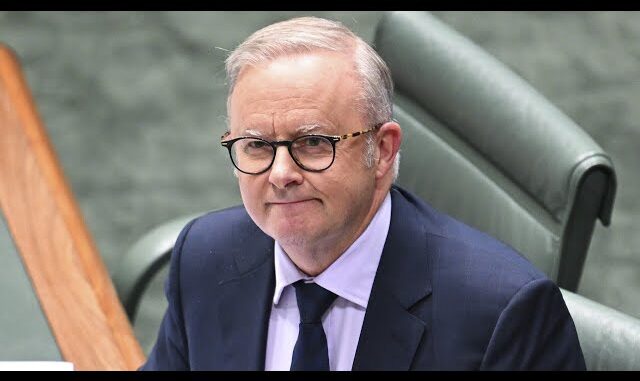
High-spending premiers remain popular and seemingly impervious to the rising cost-of-living anxiety piling pressure on the Albanese government.
Australians measure their leaders in Canberra against grocery bills, petrol prices and mortgage repayments, which are all higher than anyone would like.
Yet a considerable factor in the nation’s inflation woes, which have already resulted in one rate hike this year, likely to be followed by another, is spending beyond the control of the Commonwealth.
But premiers presiding over record infrastructure pipelines, swelling public sector wage bills and rapidly rising debt are enjoying approval ratings their federal counterparts can only envy.
Queensland Premier David Crisafulli ventured down to Canberra this week to pitch his state as a destination for investment, jobs and opportunity. (ABC News: Luke Bowden)
Premiers enjoy positive polling
Queensland Premier David Crisafulli even ventured down to Canberra this week to pitch his state as a destination for investment, jobs and opportunity.
Armed with a few dot points and unbridled enthusiasm for all things north of the border, Crisafulli spoke off the cuff for his National Press Club address.
He mostly revisited familiar stump speech themes, but it has been some time since a serving politician looked so at ease at that podium.
Even those considered strong communicators in the Albanese government tend to get bogged down in tediously overwritten speeches and infuriating non-answers.
Crisafulli defended contentious issues like Queensland’s refusal to participate in a national gun buyback and resisted repeated attempts by journalists to draw him into offering advice to his flailing federal counterparts.
His restraint was in stark contrast to Liberals in Canberra, who have recently appeared chronically incapable of recognising that not venturing an opinion can actually be politically advantageous.
Even if their governments aren’t beloved, the current crop of state premiers broadly enjoy positive personal polling.
Premiers are enjoying the political rewards of their spending, while federal leaders shoulder the inflation discontent. (ABC News)
Straight-talking premiers
Victorian Premier Jacinta Allan, who is dragged down by economic woes and more recently a CFMEU corruption scandal, is really the exception to the general rule.
Crisafulli remains buoyant more than a year into office, while in Western Australia, Labor holds 46 of the state’s 59 lower house seats and Premier Roger Cook is highly regarded.
NSW Premier Chris Minns could only dream of such a margin for Labor, while in Tasmania Premier Jeremy Rockliff sits at the helm of a minority Liberal government.
Yet both consistently enjoy comparatively high favourability ratings.
The popularity of South Australia’s Premier Peter Malinauskas is near unprecedented levels, with the Liberals facing the prospect of a total wipe-out in next month’s state election.
The source of these premiers’ likeability is no secret.
They are strong communicators who favour “straight talking” with the public.
When under pressure they usually try to tackle controversies head on or deflect to an external enemy — frequently whoever in the Commonwealth is holding the purse strings.
Federal Health Minister Mark Butler joked last week about “getting beat up” by his state counterparts and revealed he had been excluded from their WhatsApp group chat. (ABC News: Callum Flinn)
Premiers have a narrow brief
Federal Health Minister Mark Butler joked last week about “getting beat up” by his state counterparts and revealed he had been excluded from their WhatsApp group chat.
Premiers have a comparatively narrow brief: hospitals, schools and roads. And that clarity of mandate tends to produce political durability.
Images of Malinauskas enjoying a dip with his family at one of the new pools at the $135 million Adelaide Aquatic Centre he officially opened last month capture the contrast between tangible delivery and national turbulence.
When the cost of living bites, voters instinctively look to Canberra.
On many issues, the federal government absorbs national frustration even when policy levers sit with the states.
Housing supply, land release, infrastructure sequencing and public sector wages are central to inflation dynamics, yet they are largely determined in state cabinet rooms.
The popularity of South Australia’s Premier Peter Malinauskas is near unprecedented levels, with the Liberals facing the prospect of a total wipe-out in next month’s state election. (ABC News: Carl Saville)
A cautionary tale
Earlier this week, the International Monetary Fund warned state and territory spending posed a growing risk to Australia’s economy.
“As the Commonwealth is viewed as a de facto guarantor of state debt by some credit rating agencies, higher sub-national debt could eventually impact Commonwealth borrowing costs,” it said.
Net debt in Victoria is forecast to reach almost $200 billion by 2028-29, compared with $130 billion in NSW and $93 billion in Queensland.
Total net debt held by the states, territories and federal government will reach $1.1 trillion next financial year, according to the Parliamentary Budget Office.
State expenditure and debt is of course only part of Australia’s economic picture, but it rarely attracts national attention.
Ministers in the Albanese government are loath to publicly rebuke their state counterparts, and in the wake of the IMF report Treasurer Jim Chalmers was no different.
“I don’t give free advice to my colleagues,” he said.
The antagonism between levels of government during the COVID-era still stands as a cautionary tale — the public picked their premier over the former prime minister Scott Morrison every time.
But in a federation where economic decisions are shared, a more candid acknowledgement of where pressures originate may be warranted.
Until then, premiers will continue to enjoy the political rewards of their spending, while federal leaders shoulder the inflation discontent.
Leave a Reply