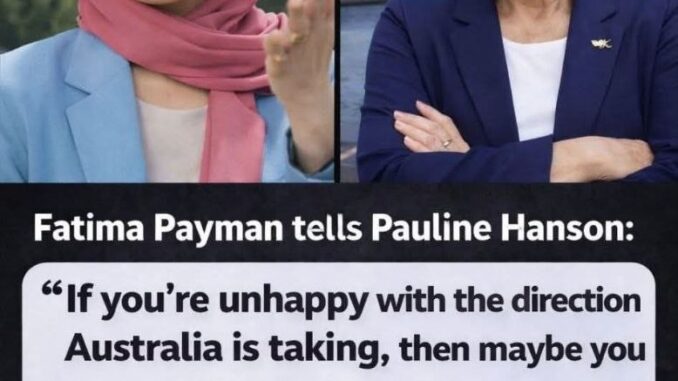
Australian politics rarely whispers. It thunders. And this week, it cracked like summer lightning after a Facebook post began circulating a quote attributed to Fatima Payman, directed squarely at Pauline Hanson:
“If you’re unhappy with the direction Australia is taking, then maybe you should consider leaving the country.”
That single sentence has ignited a digital bushfire 🔥 across timelines, talk shows, and political comment sections nationwide.
But what does it really mean? And why has it struck such a nerve?
A Clash of Political Worlds
To understand the intensity, you have to look at who is involved.
Fatima Payman represents a new chapter in Australian politics. Young, outspoken, and symbolic of a changing demographic landscape, she embodies a more multicultural and progressive vision of the nation.
Pauline Hanson, leader of One Nation, has long been one of the most polarizing figures in Australian public life. Known for her hardline views on immigration and national identity, she has built a political brand around protecting what she describes as “traditional Australia.”
When these two political forces collide, sparks are inevitable.
But this quote? It felt less like a spark and more like a detonation.
The Irony That Set Social Media Alight
Many commentators online were quick to highlight the irony. For years, Hanson has been associated with rhetoric suggesting that migrants who dislike Australia should “go back” to where they came from.
Now, critics argue, the script appears flipped.
Supporters of Payman see her remark as a pointed rebuke, a rhetorical mirror held up to Hanson’s own messaging. In their eyes, it is less an attack and more a taste of political symmetry.
Opponents, however, accuse Payman of hypocrisy. They argue that telling anyone to leave the country contradicts the inclusive values she often champions.
And so the argument spirals, as political arguments tend to do.
Freedom of Speech or Political Escalation?
Australia prides itself on robust political debate. Parliament is not a yoga retreat. It is a gladiator arena with microphones.
Yet this moment raises a broader question:
When does sharp political rhetoric become counterproductive?
Some analysts suggest that comments like this deepen ideological trenches. Others believe they expose long simmering tensions that can no longer be politely sidestepped.
Either way, the quote has become symbolic of a broader cultural conversation about identity, belonging, and who gets to define “Australian values.”
A Nation in Transition
Australia in 2026 is not the Australia of the 1990s. Demographics have shifted. Generational attitudes have evolved. Conversations around race, migration, and national identity are more layered than ever.
For some voters, change feels energizing. For others, it feels destabilizing.
That tension is not unique to Australia. It echoes across democracies worldwide. But when it surfaces in a direct exchange between two high profile politicians, it becomes headline fuel.
Political Strategy or Emotional Reaction?
Another layer to the controversy is motive.
Was Payman’s comment a calculated political statement designed to rally her base?
Was it a spontaneous response born from frustration?
Or was it a strategic attempt to challenge Hanson’s long standing narrative?
In modern politics, viral moments are currency. A single quote can dominate the news cycle for days.
And this one certainly has.
The Public Reaction: Divided and Loud
Scroll through any social media thread discussing the quote and you will find:
• Applause emojis and “finally someone said it” comments
• Accusations of double standards
• Long essays about immigration policy
• Caps lock declarations about national identity
In short, a digital microcosm of the country’s political divide.
The debate is no longer just about two senators. It has become a proxy battle over the direction Australia is taking.
The Bigger Question
At its core, this controversy forces Australians to confront something deeper than a viral quote:
Who gets to decide what Australia should look like in the future?
Is disagreement a sign of democratic health?
Or are moments like this evidence of political polarization reaching boiling point?
There are no easy answers. But one thing is certain: statements like these do not disappear quietly.
They linger. They echo. They become campaign talking points.
A Political Moment That Won’t Fade Quickly
Whether you view Fatima Payman’s words as justified pushback or unnecessary escalation, the impact is undeniable.
The exchange has reignited debates about free speech, national identity, and the tone of political discourse in Australia.
And in a media environment that thrives on confrontation, this story may be far from over.
Politics in Australia is not just policy. It is theatre. It is ideology. It is identity.
Leave a Reply