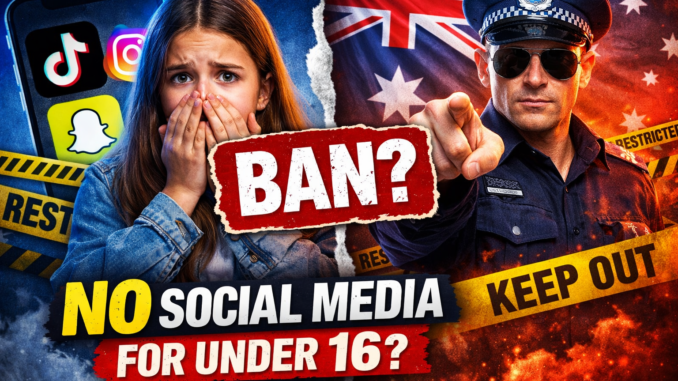
Australia is standing at the edge of a digital cliff.
A proposal to ban social media access for under 16s has exploded into one of the most emotionally charged debates in the country. Parents are cheering. Teenagers are fuming. Tech companies are sweating. And lawmakers are sharpening their arguments.
The question slicing through the nation right now:
Is this child protection… or government overreach?
Why This Is Even Being Considered
Concerns about youth mental health, online bullying, algorithm addiction, and exposure to harmful content have been building for years. Studies have linked excessive social media use to anxiety, depression, body image issues, and sleep disruption among teenagers.
Many parents feel outmatched. Platforms evolve faster than parental controls. Trends move faster than school policies.
So now policymakers are asking a bold question:
What if we simply block access until 16?
Not regulate it. Not tweak it. Ban it.
That’s not a speed bump. That’s a digital roadblock 🚧.
The Argument FOR the Ban
Supporters say this is about safeguarding childhood.
They argue:
• Algorithms are engineered for addiction
• Children lack emotional maturity to process online toxicity
• Cyberbullying has long term psychological impact
• Predators exploit open platforms
Some parents describe social media as “the new cigarettes,” addictive by design and damaging before adulthood.
To them, the ban isn’t extreme. It’s overdue.
They believe Australia could become a global leader in youth digital protection, forcing platforms to redesign their systems with minors in mind.
The Argument AGAINST the Ban
Opponents see danger in a different direction.
Critics argue:
• Teens will simply bypass restrictions with VPNs
• It pushes activity underground rather than making it safer
• Social media is now central to education and social development
• Enforcement would require intrusive age verification systems
And that’s where privacy concerns ignite 🔥.
Would platforms require ID uploads?
Biometric verification?
Government linked digital identity systems?
For many Australians, that feels like opening another Pandora’s box.
The Teen Perspective: “You’re Not Listening to Us”
Young Australians are not silent in this debate.
Many argue social media is not just entertainment. It’s community. It’s activism. It’s creative expression. It’s how they build identity and connection.
Cutting it off entirely, they say, ignores digital reality.
For teens growing up in 2026, banning social media isn’t like removing a TV from the living room. It’s like removing the town square.
Tech Giants in the Hot Seat
If Australia pushes forward, global platforms like TikTok, Instagram, Snapchat, and others would face immense pressure to implement strict age gates.
And Australia has history here. It has taken bold regulatory stances before on digital platforms.
If successful, this move could trigger a domino effect internationally.
But if it fails or becomes unenforceable, it risks becoming symbolic legislation rather than practical reform.
The Bigger Cultural Question
This debate is about more than apps.
It touches on:
• Who defines childhood in the digital era
• The role of government in family life
• The balance between safety and freedom
• Whether regulation can outpace technology
It is a generational clash wrapped inside a policy proposal.
Parents remember childhood without smartphones. Teenagers do not.
Could This Actually Work?
Practical questions remain:
• How would age be verified without violating privacy?
• Would schools enforce compliance?
• What penalties would platforms face?
• Would parents be fined if children bypass rules?
If enforcement mechanisms feel too invasive, public support could quickly erode.
If enforcement is too weak, critics will call it political theatre.
A Defining Moment for Australia
Australia has an opportunity to lead globally on youth digital safety. Or it could spark a fierce backlash about personal freedoms and digital rights.
Either way, this debate is not fading quietly.
It will shape policy discussions about technology, childhood, and privacy for years to come.
And right now, the nation is split.
Some see a shield.
Some see a leash.
Some see overdue reform.
Others see a slippery slope.
One thing is certain 📢
If Australia bans social media for under 16s, childhood in this country will never look the same again.
The question is not whether change is coming.
The question is how far Australia is willing to go.
Leave a Reply