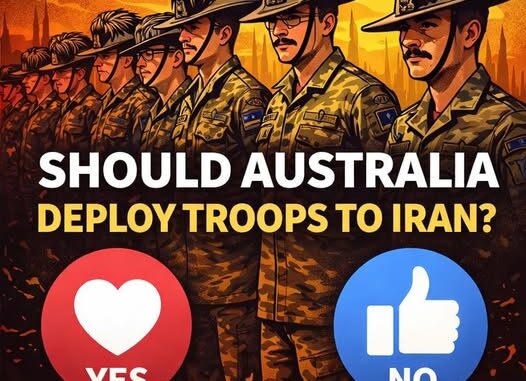
A powerful question is echoing across political circles, news studios, and social media feeds in Australia:
If tensions in the Middle East escalate, should Australia send troops?
What began as a strategic discussion among defense analysts has quickly transformed into a national debate. Some experts argue that Australia must stand firmly with its allies in any confrontation involving Iran. Others warn that doing so could drag the country into another long and costly military conflict.
The issue has opened a serious conversation about national security, international alliances, and the role Australia should play in an increasingly unstable global landscape.
Rising Tensions in the Middle East
The Middle East has long been a region where geopolitical tensions can escalate rapidly. In recent years, friction between Iran and several Western-aligned nations has intensified, raising fears about the possibility of a wider military confrontation.
When tensions rise in that region, countries across the world begin evaluating their strategic positions and alliances.
For Australia, the question is not hypothetical. As a long-standing partner of major Western powers, its foreign policy decisions often intersect with global security operations.
If a major conflict involving Iran were to unfold, pressure on Australia to respond could increase significantly.
The Alliance Factor
One of the biggest reasons the debate has gained momentum is Australia’s strong network of international alliances.
For decades, Australia has worked closely with partners like the United States and other Western allies on global security issues.
Supporters of a potential military role argue that alliances are built on mutual support. If close partners become involved in a conflict, they say Australia should be prepared to stand beside them.
From this perspective, maintaining strong alliances helps preserve international stability and deters future threats.
Military cooperation, according to this argument, is part of Australia’s responsibility as a trusted global partner.
Critics Warn of Another Long War
Not everyone agrees with that approach.
Critics point to past conflicts where military involvement led to years of fighting, significant costs, and difficult consequences for returning soldiers and their families.
They argue that deploying troops to a new conflict zone could expose Australian personnel to serious risks without clear long-term benefits.
Some analysts also warn that conflicts in the Middle East often become complicated and prolonged, involving multiple regional actors and unpredictable developments.
From this perspective, caution should guide any decision involving military deployment.
For many Australians, the thought of entering another distant conflict raises difficult memories of past wars.
The Human Cost of Military Decisions
Whenever discussions about war arise, one factor inevitably comes into focus: the people who would be sent to serve.
Australian soldiers have participated in numerous international missions over the decades, often under challenging and dangerous conditions.
Those who oppose involvement in a potential conflict with Iran emphasize that military decisions carry real human consequences.
Behind every deployment order are thousands of service members and their families who must face the uncertainties of war.
That reality makes the debate deeply personal for many Australians.
A Strategic Crossroads for Australia
Beyond the immediate question of military action, the debate also reflects a larger issue about Australia’s role on the global stage.
Should Australia take an active role in international conflicts alongside its allies?
Or should it adopt a more cautious strategy that focuses primarily on regional security and diplomacy?
Different political leaders, analysts, and citizens hold different views on the matter.
Some believe strong alliances and global engagement help keep Australia safe.
Others argue that distance from global conflicts may be the better path for long-term stability.
Public Opinion Is Divided
As news of rising tensions circulates, Australians are increasingly discussing the issue.
Online forums, television debates, and community discussions have all begun exploring the same question from different angles.
Supporters of military cooperation stress loyalty to allies and global stability.
Opponents emphasize the importance of protecting Australian lives and avoiding another prolonged war.
This divide reflects how complex modern international politics has become.
Few issues capture the intersection of security, diplomacy, and national identity quite like the question of war.
The Question Facing Australians
For now, the debate remains hypothetical.
But geopolitical tensions can evolve quickly, and governments must often make difficult decisions under intense pressure.
If the situation in the Middle East were to escalate significantly, leaders in Australia might eventually face a choice that could shape the country’s foreign policy for years to come.
Until then, the discussion continues.
What Do You Think?
Australians are now confronting an important question about their country’s role in global security.
If conflict were to escalate involving Iran, should Australia stand alongside its allies?
Or should it avoid military involvement and focus on diplomacy?
⚖️ Should Australia send troops if a conflict with Iran escalates?
🟢 YES – Stand with allies
🔴 NO – Avoid another war
Share your thoughts and join the growing national debate.
Leave a Reply