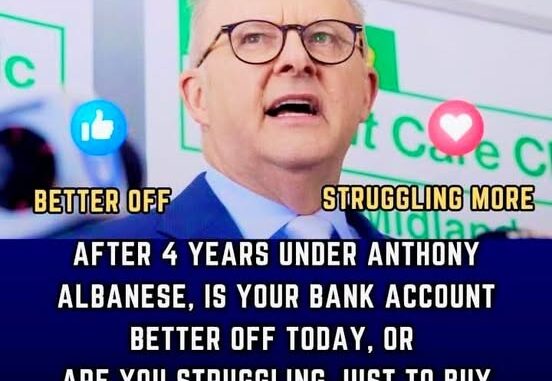
Politics often promises brighter days ahead. Campaign speeches are filled with hopeful visions of economic growth, stronger wages, and a better quality of life for everyday families. But when the speeches fade and the years pass, people begin asking a much simpler question:
Is life actually better?
After four years under the leadership of Anthony Albanese, many Australians are now taking a hard look at their finances. Instead of focusing on policy announcements or political headlines, they are checking something far more personal:
Their bank accounts.
For some households, things may feel stable or even improved. For others, the rising cost of living has made everyday expenses feel like climbing a steep hill with no clear summit.
And across the country, the debate is growing louder.
The Cost of Living Reality Check
Walk into a supermarket today and the difference can feel immediate. Items that once seemed routine purchases now make people pause before putting them in the cart.
Groceries, electricity, fuel, rent, and mortgage payments have all become major points of discussion among Australians.
Many families say the weekly grocery bill has quietly transformed into one of their biggest financial stresses. A quick trip for a few essentials can suddenly cost far more than expected.
For households already balancing rent, utilities, and transportation costs, even small increases can create real pressure.
It is this everyday experience that has sparked a broader national conversation about the economic direction of the country.
Supporters Say Progress Takes Time
Supporters of Anthony Albanese argue that economic challenges are rarely solved overnight.
They point out that governments often inherit complex financial conditions shaped by global markets, previous administrations, and unexpected events like economic slowdowns or international conflicts.
From this perspective, judging a government purely on short term cost of living pressures may overlook longer term economic strategies designed to stabilize the country’s financial future.
Supporters also highlight efforts to address wages, employment opportunities, and broader economic reforms that aim to strengthen Australia’s economy over time.
In their view, progress is happening even if the results are not immediately visible in every household budget.
Critics Say Australians Are Feeling the Squeeze
On the other side of the debate are Australians who say the numbers in their bank accounts tell a very different story.
For them, the issue is not economic theory or policy explanations. It is the reality of paying bills at the end of the month.
Many people feel that their salaries are struggling to keep pace with rising expenses. Mortgage holders have faced higher repayments. Renters are seeing housing costs climb. Everyday essentials have become noticeably more expensive.
For these Australians, the question is simple:
If the economy is improving, why does life feel harder?
This frustration has fueled a growing wave of public debate across social media, talk shows, and political discussions nationwide.
The Kitchen Table Economy
Economists often discuss complex indicators such as inflation rates, GDP growth, and employment statistics. But for everyday citizens, the most important economic indicator sits right on the kitchen table.
It is the weekly budget.
Can the family afford groceries without stress?
Is there money left after paying rent or mortgage?
Are people able to save anything for emergencies or the future?
When these questions start producing uncomfortable answers, political debates suddenly become very personal.
A Nation Reflecting on Four Years
After four years of leadership under Anthony Albanese, Australians are reflecting on how their lives have changed.
Some say they feel secure and believe the country is moving in the right direction. Others feel like their financial footing has become less stable.
The divide highlights an important truth about modern economies: national statistics and personal experiences do not always tell the same story.
A country can show economic growth while many individuals still struggle with day to day costs.
And that gap between national success and personal hardship often becomes the center of political debate.
The Bigger Question for Voters
Ultimately, this conversation is about more than grocery prices or bank balances.
It is about how people measure progress.
Some voters focus on long term national stability and economic reforms. Others judge leadership based on how easily they can pay bills each month.
Both perspectives are valid, and both shape how citizens evaluate their government.
As Australia continues navigating economic challenges, these discussions will likely become even more important.
Because when election seasons arrive, voters rarely forget how their finances felt during the previous years.
Now Australians Are Asking One Question
After four years under Anthony Albanese, people across the country are looking at their wallets and asking themselves something very direct:
Is my life financially better today than it was four years ago?
Some Australians feel confident about the future.
Others feel like they are working harder just to maintain the same standard of living.
So now the question goes to you.
💰 Are you better off financially today?
🛒 Or are groceries and everyday costs becoming harder to manage?
Share your thoughts and join the debate. Because in the end, the true measure of an economy is not just in statistics… it is in the lives of the people living in it.
Leave a Reply